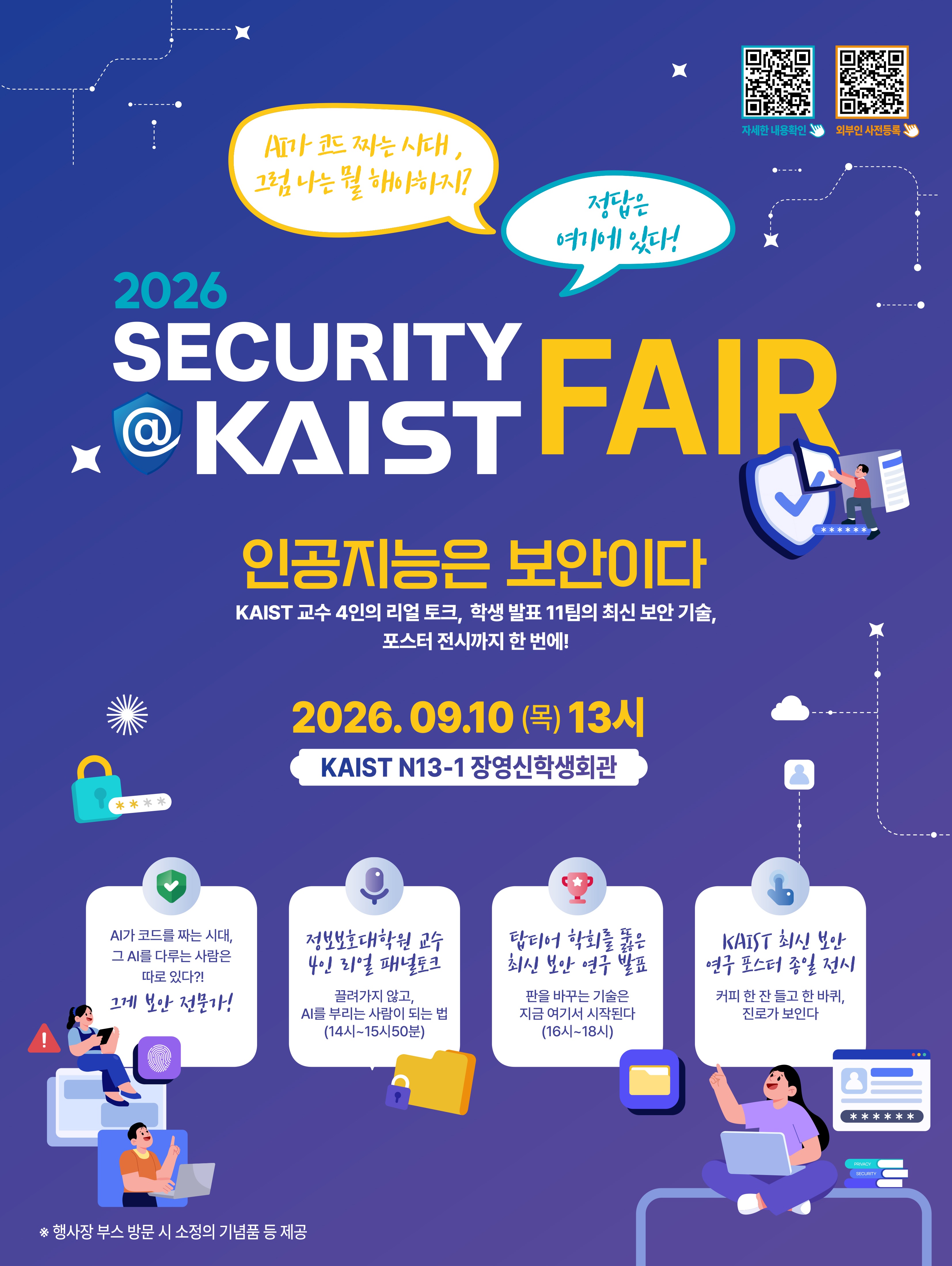
지금 바로 사전등록하세요!
Security@KAIST Fair 2026에 참여하시려면 사전등록이 필요합니다.
사전등록을 통해 더 나은 행사 경험을 제공해드립니다.
발제
차상길 교수 : 인공지능은 보안이다
한준 교수 : 피지컬 AI보안의 미래
허기홍 교수 : 논리와 직관이 융합된 검증형 AI로 만들어 갈 미래
패널 토의
사회자 : 손수엘 교수
패널(4인) : 차상길 교수, 한민기 교수, 한준 교수, 허기홍 교수
| 시간 | 프로그램 |
|---|---|
| 13:00 ~ 14:00 |
등록, 포스터 전시 |
| 14:00 ~ 14:50 |
Security@KAIST 워크숍 (발제) 차상길 교수, 한준 교수, 허기홍 교수 |
| 14:50 ~ 15:00 |
휴식 |
| 14:00 ~ 15:50 |
Security@KAIST 워크숍 (패널 토의) 손수엘 교수, 차상길 교수, 한민기 교수, 한준 교수, 허기홍 교수 |
| 15:50 ~ 16:00 |
휴식 |
| 16:00 ~ 16:11 |
Expecto: 자연어 의도로부터 엄밀한 명세 생성하기 좌장 : 정동재 박사 (사이버보안연구센터) / 발표자 : 이동재 (허기홍 교수님 연구실) 대규모 언어 모델(LLM)이 발전함에 따라 명세 주도 개발(specification-driven development, SDD)은 소프트웨어 개발에서 유망한 패러다임으로 부상하고 있다. 그러나 자연어 명세에 의존하는 방식은 모호성을 야기하며, 정확성을 보장하기 어렵다. 이러한 문제를 해결하기 위해, 자연어 의도에서 신뢰할 수 있는 엄밀한 명세(formal specification)를 자동으로 추출하는 시스템인 Expecto를 제안한다. 핵심 아이디어는 명세 추출이라는 복잡한 작업을 다루기 쉬운 단위로 분해하는 하향식 모듈형 명세 합성 알고리즘이다. 하향식 합성은 LLM의 추론 복잡도를 낮추고, 추출된 명세의 정확도를 향상시킨다. 실험 결과, Expecto는 단일한 순수 LLM 기반 접근 방식에 비해 추출된 명세의 정확도를 크게 향상시킨다. 또한 Defects4J의 실제 버그가 포함된 프로그램에 적용했을 때, Expecto는 기존 기준선보다 더 많은 버그를 탐지할 수 있는 형식 명세를 성공적으로 생성하였다. |
| 16:11 ~ 16:22 |
On the Security Risks of Memory Adaptation and Augmentation in Data-plane DoS Mitigation 좌장 : 정동재 박사 (사이버보안연구센터) / 발표자 : 남호철 (강민석 교수님 연구실) Data-plane programmability in commodity switches is reshaping the landscape of denial-of-service (DoS) defense by enabling adaptive, line-rate mitigation strategies. Recent systems like Cerberus [SP'24] augment limited switch memory with control-plane support to rapidly respond to evolving attacks. In this paper, we reveal a subtle yet critical vulnerability in this model; that is, the very mechanisms that enable the defense system’s agility and scalability can be subverted by a new class of coordinated DoS attacks. We present Heracles, the first attack to exploit hardware-level constraints in programmable switches to orchestrate precise resource contention across data-plane and control-plane memory. By leveraging side-channel timing signals, Heracles triggers synchronized augmentation, memory squeezing, and time-window exploitation, which are three orthogonal contention strategies that significantly degrade or even completely disable the DoS mitigation capabilities. We implement and test Heracles against real Tofino hardware and show that it can reliably disrupt DoS defenses across diverse DoS attack profiles, even when using loosely (1–2 second) time-synchronized attack sources. To mitigate this threat, we propose Shield, a multi-layered DoS mitigation sketch architecture that decouples memory operations across control- and data-plane layers, effectively mitigating the Heracles attack while preserving both line-rate performance and detection accuracy. |
| 16:22 ~ 16:33 |
Connecting the Dots: An Investigative Study on Linking Private User Data Across Messaging Apps 좌장 : 정동재 박사 (사이버보안연구센터) / 발표자 : 이소영 (손수엘 교수님 연구실) 이 연구는 KakaoTalk, Telegram, WhatsApp, Signal, Tinder와 같은 모바일 메신저 앱에서 발생할 수 있는 개인정보 위협을 분석한다. 특히 연락처 검색, SSO 기반 계정 연동, 주변 사용자 검색 기능이 악용될 경우, 여러 플랫폼에 흩어진 사용자 정보를 서로 연결할 수 있음을 보여준다. 실험에서는 전화번호와 프로필 사진을 연결 단서로 사용해 익명 사용자의 이름을 식별하고, 위치를 평균 324m 오차로 추론할 수 있는 cross-platform linking attack을 제시한다. 이를 통해 메신저 앱의 연락처 검색 정책과 계정 연동 기능에 대한 보안 강화가 필요함을 강조한다. |
| 16:33 ~ 16:44 |
Branch-Level Fault Localization in ADS Planning via Temporal Coverage Analysis 좌장 : 정동재 박사 (사이버보안연구센터) / 발표자 : 우상민 (김용대 교수님 연구실) Planning failures in Automated Driving Systems (ADS) are increasingly detected through simulation-based testing, yet localizing their root causes within planning code remains a major challenge. Planning modules execute complex rule-based decision logic over hundreds of frames in a closed-loop interaction with the environment, where faults trigger observable failures only after temporal gaps and under specific execution contexts. These characteristics make traditional spectrum-based fault localization ineffective, as faulty behavior is obscured by execution-level coverage aggregation and limited test diversity. In this paper, we study the problem of debugging planning failures and present a temporal coverage analysis approach for localizing faults in rule-based planning modules. Our key insight is that, while execution-aggregated coverage masks fault behavior, frame-level execution dynamics reveal distinctive temporal signatures that indicate when and how faulty branches activate. Leveraging this insight, our approach first identifies a suspicious frame using planning semantics, and then ranks candidate branches by analyzing their execution behavior within a localized temporal window. We evaluate our approach on 221 reproducible non-collision Apollo planning failures, covering immobility and emergency mission failures. Our results show that temporal coverage analysis enables accurate suspicious-frame identification and substantially reduces branch inspection effort compared to oracle-based and random baselines, effectively localizing faults from a single failing execution. We further analyze failure cases that lack observable execution signals to clarify the fundamental limits of execution-based localization. Overall, this work demonstrates that temporal execution analysis provides a practical and effective foundation for debugging planning failures in rule-based ADS planning modules. |
| 16:44 ~ 16:55 |
Denied by Border: Denial-of-Service Attack Exploiting Location Restrictions in Non-Terrestrial Networks 좌장 : 박기창 박사 (사이버보안연구센터) / 발표자 : 김광민 (김용대 교수님 연구실) 본 발표에서는 3GPP 비지상 네트워크(NTN)의 위치 기반 접속 제한 절차를 악용한 새로운 서비스 거부 공격인 Denied by Border를 소개한다. 위성 빔은 국경을 넘어 넓은 지역을 커버할 수 있지만, 이동통신 사업 허가와 규제는 국가마다 다르기 때문에 허가받지 않은 지역까지 서비스가 제공될 수 있다. 이를 방지하기 위해 NTN은 위성 기지국이 보고한 위치 정보를 바탕으로 특정 지역에서의 이동통신 접속을 제한한다. 그러나 네트워크가 단말의 실제 위치보다 위성 기지국이 제공한 위치 정보를 신뢰한다는 점을 이용하면, 공격자는 피해 단말의 시그널링 메시지를 서비스 금지 지역으로 중계하여 네트워크가 정상적인 접속 거절 메시지를 생성하도록 유도할 수 있다. 해당 메시지는 무결성 보호가 적용되어 있어 피해 단말은 이를 정상적인 네트워크 명령으로 받아들이고 통신사 접속을 차단하게 된다. 상용 NTN 지원 단말을 대상으로 평가한 결과, 공격으로 인해 지속적인 서비스 거부 상태가 발생했으며, 반복 공격을 통해 통신 차단을 연장할 수 있음을 확인했다. 또한 NTN에서 유도된 접속 제한이 동일한 통신망 식별자를 사용하는 지상망 접속으로까지 확산될 수 있고, 일부 구현에서는 지상망 환경에서도 접속 차단 문제가 발생할 수 있음을 보였다. 본 연구는 기존 표준에서 제안하는 위치 검증 기법만으로는 이를 우회하려는 공격자를 충분히 방어하기 어렵다는 점을 분석하고, 프로토콜 변경 없이 적용할 수 있는 완화 방안을 제안한다. 해당 취약점은 GSMA에 책임 있는 공개 절차를 통해 보고되어 확인을 받았으며, 현재 관련 표준화 단체와 후속 대응을 논의하고 있다. |
| 16:55 ~ 17:05 |
Function-Level Fuzzing for RTOS Kernels with RTCon 좌장 : 박기창 박사 (사이버보안연구센터) / 발표자 : 이은규 (윤인수 교수님 연구실) Real-Time Operating System (RTOS) is widely used in embedded systems with its various subsystems such as Bluetooth and Wi-Fi. As RTOS functionality continues to expand, the corresponding attack surface also increases, creating greater exposure to security threats. Nevertheless, existing dynamic testing approaches, such as fuzzing, struggle to thoroughly exercise deeply embedded kernel functions because invoking these functions often requires complex execution contexts. In this talk, we introduce a context-adaptive function-level fuzzer for RTOS kernels. RTCon enables function-level fuzzing of arbitrary RTOS kernel functions by adaptively generating execution contexts. It also uses multi-layer classification to prioritize high-confidence crashes. Evaluated on Zephyr, RIOT, FreeRTOS, and ThreadX, RTCon found 27 bugs, including 25 previously unknown vulnerabilities, and received 14 CVEs. Its crash classifier achieved 92.7% precision for high-confidence crashes, compared with 5.8% for low-confidence ones. |
| 17:05 ~ 17:16 |
iROV: Breaking the Silence of RPKI with Interactive Validation 좌장 : 박기창 박사 (사이버보안연구센터) / 발표자 : 김윤수 (강민석 교수님 연구실) While Route Origin Validation (ROV) effectively mitigates prefix hijacking, it drops BGP updates that are inconsistent with currently published ROAs without consulting the prefix owner. This leaves resource owners unaware of benign misconfigurations, blind to prefix hijacking attacks, and unable to execute urgent routing maneuvers like DDoS redirection. We propose iROV to address these limitations by transforming validation from a static local decision into an interactive, owner-assisted process. iROV enables routers to query owners for “Just-in-Time” authorization of invalid routes. To mitigate availability threats introduced by this interactivity, iROV employs validity stapling to suppress redundant queries, and rate-limited querying to prevent targeted abuse. Large-scale simulations and a prototype implementation demonstrate that iROV restores reachability for urgent route changes from 23% to nearly 90%, and delivers rapid feedback on anomalies with granular impact estimation, while incurring negligible overhead. |
| 17:16 ~ 17:27 |
Hide-and-Sweep: Detecting Concealed Cameras via LED Illumination Sweeps 좌장 : 박기창 박사 (사이버보안연구센터) / 발표자 : 윤종혁 (한준 교수님 연구실) Hidden cameras have increasingly infiltrated hotel and Airbnb rooms, posing serious privacy risks. Detecting such cameras is challenging because they are visually inconspicuous and often embedded inside everyday objects. Even worse, existing handheld detectors are manual and also rely on single-angle illumination and hence suffer from high false-positive rates. We present SweepLED (pronounced "sweepled"), a practical hidden camera detection system that operates on a commodity smartphone augmented with an unobtrusive LED-embedded case. SweepLED performs LED sweeping - a controlled sequence of multi-angle illumination - while the user simply holds the phone still by hand, enabling the camera to capture how reflections evolve under changing lighting. This reveals stable, lens-specific cues that distinguish hidden camera lenses from ordinary reflective objects, enabling robust detection with low user effort. We implement SweepLED using a compact hardware add-on and evaluate it in realistic environments containing 12 hidden-camera objects and 18 commonly reflective non-camera items. Our results demonstrate that SweepLED provides accurate and reliable hidden-camera detection using only unobtrusive smartphone-compatible hardware, achieving approximately 94% detection accuracy with a sweep time of under 5 s and a core component cost of less than USD $7. |
| 17:27 ~ 17:38 |
양자시대의 보안 준비하기 좌장 : 고영민 박사 (사이버보안연구센터) / 발표자 : 한민기 교수 양자컴퓨터의 빠른 발전과 함께 기존 암호와 보안 체계의 안전성에 대한 우려가 커지고 있다. 이에 따라 세계적으로 기존 암호를 양자컴퓨터에 안전한 양자내성암호로 변경하려는 국가적 노력들이 이어지고 있다. 이 발표에서는 양자컴퓨터의 현재 발전 상황을 간략하게 돌아보고, 양자컴퓨터에 대한 암호학계의 대비와 새로운 기회에 대해 논의할 것이다. |
| 17:38 ~ 17:49 |
Leveraging Biometric-Rich Hand Gestures for Head-Mounted Display Authentication 좌장 : 고영민 박사 (사이버보안연구센터) / 발표자 : Ian Oakley 교수 User authentication on head-mounted displays (HMDs) relies on passwords, which are cumbersome to input and susceptible to shoulder-surfing attacks. Recent research has revealed that behavioral signals collected during common HMD tasks are highly distinctive between users. Building on these findings, this paper presents a knowledge-driven behavioral authentication system for HMDs. Our system leverages user-defined gestures as cues and trains an anomaly detector on hand joint motion signals for each user. To evaluate effectiveness, we conducted a comprehensive multi-session user study (n = 20) and an observation attack study (n = 10). The results show that gestures secured with joint motions are resilient to worst-case scenario video-based observation attacks (AUC = 0.97, EER = 3.58%) and maintain high recall performance over one week (AUC = 0.93, EER = 9.82%). These findings suggest that user-generated biometric hand gestures offer a promising approach to securing HMDs. |
| 17:49 ~ 18:00 |
Precise Type Inference for Next-Generation EVM Decompilation 좌장 : 고영민 박사 (사이버보안연구센터) / 발표자 : 김정현 (차상길 교수님 연구실) Analyzing EVM bytecode is imperative because nearly 45% of smart contracts on the Ethereum blockchain lack publicly available source code. While type inference is pivotal for EVM bytecode analysis, it remains unsolved because (1) current tools can only handle a subset of Solidity expressions, and (2) they often produce imprecise results due to unsound heuristics they employ. Furthermore, there is no comprehensive dataset with precise ground truth for evaluating EVM type inference, which hinders the development of new tools and the evaluation of existing ones. Thus, we propose EVMpress, a novel bytecode analysis framework that enables accurate type inference for Solidity expressions found in EVM bytecode. We evaluate EVMpress on the largest-to-date dataset of EVM bytecode containing more than 370K real-world contracts with precise ground truth for every function and variable. Our evaluation results show that EVMpress significantly outperforms existing state-of-the-art tools in terms of its coverage and accuracy. We publicize our dataset as well as our implementation of EVMpress to facilitate future research in EVM bytecode analysis. |
|
Connecting the Dots: An Investigative Study on Linking Private User Data Across Messaging Apps 강준규 (손수엘 교수님 연구실) Mobile messaging apps have become an integral part of daily communication with massive user bases (e.g., over 950 million on Telegram and 48.7 million on KakaoTalk). To boost user engagement and user base, messaging apps offer diverse context-rich and platform-specific features, such as nearby user search, contact discovery, and single sign-on (SSO)-based account linking. While these features enable users to adopt multiple messaging apps on a single mobile device, they also introduce privacy risks of linking private user information across multiple message apps, which remains understudied. This paper presents an in-depth analysis of privacy threats in widely used messaging apps in South Korea, including KakaoTalk, Telegram, WhatsApp, Signal and Tinder, demonstrating concrete attacks exploiting their contact discovery, SSO-based account linking, and nearby user search features to compromise user privacy. More importantly, we chain the attacks to conduct the first cross-platform linking attack, which enables adversaries to deanonymize user names and infer users’ physical locations with an average error margin of 324 meters for a large number of untargeted and targeted users. Our findings highlight that securing contact discovery is crucial as permissive contact discovery policies allow adversaries to exploit phone numbers and profile images as linking keys to connect private user information across multiple messaging apps. We discuss and propose mitigation strategies to alleviate the presented threats. |
|
PIN Inference Attack on Touch Keypad Door Locks via RF Backscatter Side Channel 강창건, 서동진 (한준 교수님 연구실) Touch keypad door locks secure homes and offices with the PIN as their primary credential, so a leaked PIN grants immediate physical access. We present ScatterPIN, a practical PIN inference attack that runs on a commodity software-defined radio (SDR) and exploits the backscatter side channel of the lock’s internal serial communication. The key insight is that the lock transmits key-specific data over its internal communication line, which ScatterPIN observes as a unique per-key signal from a distance through backscatter when an external RF source illuminates the device. ScatterPIN then infers the PIN from a distance by identifying each keystroke from its per-key signal, without physical tampering or any prior compromise of the lock or the user’s devices. We implement ScatterPIN on a commodity SDR and analyze com- mercial touch keypad door locks from multiple manufacturers to identify their attack surface, revealing the key structural factors that expose these devices to remote PIN recovery. |
|
Confidence-Weighted Security Posture Assessment: Prioritizing Security Investment with Partially Verified Inputs 고영민 (사이버보안연구센터) Quantifying the security posture of an enterprise requires the assessor to state how well each deployed security solution counters each attack technique. Organizations without a dedicated security team cannot verify every entry, so only part of the input is confirmed while the rest is estimated. Existing frameworks weight both kinds of input equally; consequently, when an unverified area is entered optimistically, that area is pushed down the investment priority list. This paper proposes assigning different confidence weights to values confirmed through the enterprise’s own operation of the solution and to values that are estimated, so that the areas genuinely requiring additional security investment are quantified in a way that reflects what the organization actually knows. We derive the true pertechnique coverage of a solution type from public detectionevaluation results, treat it as ground truth, and reconstruct an enterprise situation in which part of the input is unknown. In a five-technique case, the coverage estimation error decreased from 0.44 to 0.30, and under a two-item budget the number of correctly selected investment targets increased from one to two. The method requires no additional measurement and is therefore applicable to organizations with limited verification capacity. |
|
AutoScale: Vision-Based Overweight Truck Detection Utilizing a Following Autonomous Vehicle 김규연 (한준 교수님 연구실) Overweight trucks increase crash risk and accelerate road and bridge deterioration, causing significant costs. To mitigate this, authorities deploy weighing sensors beneath roadways, but these systems are easy to bypass due to their fixed locations. To overcome this limitation, we present AutoScale, a vision-based overweight truck detection system that utilizes autonomous vehicles. When a truck traverses a speed bump, a following autonomous vehicle on the road records it with a camera, recovers the truck’s subtle motion from the video, and estimates its weight remotely. By leveraging autonomous vehicles, whose locations are difficult to anticipate, together with widely deployed speed bumps, AutoScale reduces opportunities for trucks to avoid detection compared with fixed weighing sensors. We evaluate AutoScale on real-world driving data collected over 88 km, including 1040 speed bump traversals, and in a simulated environment. AutoScale achieves a mean absolute percentage error of 4.0%, demonstrating the feasibility of overweight truck detection from an autonomous vehicle. |
|
Behavior augmented Authorship verification on static image 김나영 (한준 교수님 연구실) 본 연구는 정적 디지털 드로잉 이미지와 실제 드로잉 과정(stylus sensor stream)을 함께 제공하는 paired drawing–behavior dataset을 구축하고, 이를 이용해 정적 이미지에서 drawing behavior를 복원(recover)하는 방법을 제안한다. 또한 복원된 행동 정보를 이미지 표현과 결합함으로써, 보지 못한 작가(unseen artists)에 대한 authorship verification 성능을 향상시킬 수 있음을 보인다. |
|
Never Ask a Function Identifier How It Found That Function 김세훈 (차상길 교수님 연구실) Function identification is a prerequisite for binary analysis, but final precision and recall do not explain which assumptions inside an identifier actually hold. This work studies function identification at the component level by decomposing common logic into assumptions about call targets, tail calls, unwind metadata, jump tables, code/data separation, and return behavior. We build a ground-truth pipeline for these intermediate facts and evaluate stripped Coreutils, Binutils, and SPEC binaries compiled with GCC/ Clang across multiple architectures, PIE settings, and optimization levels. Our analysis shows that assumption failures are not uniformly distributed, but depend on architecture-, compiler-, and optimization-specific binary idioms. Some metadata sources provide precise but incomplete evidence, some control-flow patterns blur the boundary between local edges and interprocedural transfers, and some compiler-generated code shapes do not match source-level function structure. By measuring these failures directly, the study explains how individual components create candidates, miss valid entries, or require stronger ground truth beyond final function-entry labels. |
|
일단 묻고 더블로 가: 추측 후 검증을 통한 제어 흐름 그래프 복원 김정현 (차상길 교수님 연구실) 기존 점프 테이블 분석은 경계 검사가 사라진 최적화 바이너리에서 정확도가 크게 떨어진다. 우리는 기존 분석이 놓치는 점프 테이블의 경계를, 먼저 과감히 추측하고 제어 흐름 그래프의 모순을 이용해 차후에 수정하는 추측 기반 제어 흐름 그래프 복원을 제안한다. 이를 통해 점프 테이블과 호출 후 복귀하지 않는 함수를 더 정확하고 효율적으로 복원했다. |
|
TestCraft: Intel 명세 기반 자동 테스트 생성 프레임워크 김준태 (사이버보안연구센터) 바이너리 분석의 신뢰성은 명령어 디코딩과 중간 표현 변환의 정확성에 달려 있다. 그러나 기존 테스트 방식은 개발자가 명령어 바이트코드와 기대 결과를 직접 작성해야 하므로, 복잡한 인코딩 규칙과 다양한 오퍼랜드 조합을 충분히 다루기 어렵다. 본 논문은 아키텍처 명세서로부터 실행할 수 있는 바이트코드와 테스트 코드를 자동으로 생성하는 검증 프레임워크인 TestCraft를 제안한다. TestCraft는 명세서의 명령어 정보를 통일된 구조로 정규화하고, 명령어 형식에 따라 달라지는 인코딩 요소를 구체화하여 유효한 바이트코드를 생성한다. 생성된 바이트코드는 널리 사용되는 역어셈블 도구들과 교차 검증을 거쳐 테스트 오라클로 활용된다. 바이너리 분석 도구 B2R2를 대상으로 평가한 결과, TestCraft는 10종의 결함을 발견하였다. 이는 명세 기반 자동화가 수작업 테스트에서 발생할 수 있는 문제를 보완하고, 다양한 인코딩 조합을 체계적으로 검증할 수 있음을 보여준다. |
|
더 정밀하고 똑똑한 지향성 퍼징 맞춤형 값 덮이 김태은 (허기홍 교수님 연구실) 지향성 퍼징(Directed Fuzzing)은 주어진 오류 의심 지점에서 오류를 발견하는 것을 목표로 한다. 오류를 신속하게 발견하기 위해서는 목표 지점에 도달하는 것뿐만 아니라 해당 지점에서의 다양한 실행 상태를 탐색해야 한다. 그러나 기존 퍼징 도구들은 프로그램 실행을 구문 수준의 덮이(Coverage)로만 요약해 기록하여 세부적인 상태 변화를 포착하지 못하며, 입력 변형 시에도 목표와 무관한 영역까지 무작위로 변형하는 비효율성을 보인다. 이에 대한 대안으로 본 연구는 목표 지점과 연관된 변수의 값을 함께 관찰하는 값 덮이(Value-Sensitive Coverage)와 목표 지점을 고려하여 정교하게 입력을 변형하는 지향성 입력 변형(Directed Mutation) 기술을 제안한다. 이 두 기술을 적용한 결과 더욱 세밀한 상태 탐색이 가능해졌으며, 오류 발견 횟수를 증가시키는 동시에 오류 발견 시간도 단축하는 효과를 확인하였다. |
|
하나를 보면 열을 아는 뉴로심볼릭 코드 모델 학습 류연희 (허기홍 교수님 연구실) 언어 모델이 작성한 프로그램의 신뢰성을 제고하기 위해 스펙을 활용하는 방법이 주목받고 있다. Dafny와 Verus 는 프로그램 코드 수준에서 스펙과 동작을 함께 기술할 수 있는 언어로, 언어 모델이 스스로 스펙을 작성하도록 할 수 있는 유용한 언어다. 하지만 Python, Java, C 와 같은 대중적인 프로그래밍 언어에 비해 Dafny, Verus 와 같은 비주류 언어에서는 비교적 언어 모델의 프로그램 작성 성능이 떨어진다. 비주류 언어를 추가 학습하면 성능을 개선할 수 있지만, 거대 언어 모델을 학습하는 데 충분한 오픈 소스 데이터를 수집하기가 어렵다. 우리는 비주류 언어의 적은 데이터에서도 언어 모델을 효과적으로 학습시킬 수 있는 뉴로-심볼릭 학습 방법을 제안한다. 프로그래밍 언어의 문법 규칙을 학습 시점에 효과적으로 적용하여 적은 데이터로도 모델을 효과적으로 학습할 수 있다. |
|
Architecture-Grounded Threat Modeling for 6G Non-Terrestrial Networks: Integrating ENISA Context with SPARTA Techniques 문예성 (사이버보안연구센터) Sixth-generation non-terrestrial networks (6G NTN) can distribute communication and mission-operations functions across terrestrial, aerial, and space infrastructure. Threat analysis must therefore connect a selected deployment, sector threat context, adversary techniques, and enforceable controls. The European Union Agency for Cybersecurity (ENISA) Space Threat Landscape supplies lifecycle, asset, threat, impact, and control context, whereas the Space Attack Research and Tactic Analysis (SPARTA) matrix supplies space-specific adversary techniques and countermeasures. Neither source alone connects deployment-specific assets and authority conditions to compatible techniques and control locations. This paper proposes a security-oriented reference architecture that separates service/network, mission-operations, and lifecycle/artifact-admission planes and marks trust boundaries only when documented changes in operator, policy, identity, command authority, assurance, or lifecycle control affect technique compatibility or control placement. A malicious-commanding example illustrates how the architecture scopes ENISA context, constrains compatible SPARTA techniques, and locates layered controls. The result is an architecture-grounded basis for relating the two sources without asserting universal ENISA-to-SPARTA equivalence. |
|
LLM-Assisted Command Syntax Extraction for Flight Software Fuzzing 박건우 (차상길 교수님 연구실) Flight software (FSW) controls mission-critical spacecraft operations, making its vulnerabilities potentially mission-disrupting. However, conventional coverage-guided fuzzers rarely generate inputs that satisfy FSW’s strict command syntax, while manually recovering that syntax is costly and unscalable. We present SatFuzz, which uses an LLM to extract command syntax from call graphs, source code, and manuals. Evaluations on NASA cFS, SUCHAI, and C2A show that SatFuzz achieves higher coverage and discovers more vulnerabilities than conventional coverage-guided fuzzing. |
|
PCAP-based Next-Tactic Prediction using RAG-augmented LLM 박상류 (사이버보안연구센터) While network-based cyberattacks continue to proliferate, conventional intrusion detection systems remain limited to post-facto detection, failing to predict potential future attack tactics. To address this limitation, this paper proposes an LLM pipeline that sequentially predicts MITRE ATT\&CK Tactics by depth, fusing features extracted from network packet files (.pcap) with a Retrieval-Augmented Generation (RAG) Knowledge Base built on real-world APT security reports. The proposed system extracts network-level features from live traffic and retrieves threat intelligence from a Knowledge Base that combines LLM-summarized security reports with MITRE ATT\&CK Tactic descriptions. The retrieved context and extracted features are then fed into the LLM to predict subsequent tactics. Experimental results demonstrate that the integration of RAG consistently improves Hit@K and MRR across all evaluated models. Notably, gpt-oss:20b exhibited a 47.1\% improvement in Hit@5, confirming that threat intelligence context significantly contributes to next-tactic prediction. |
|
Prism: A Multi-Team Orchestration of LLM Agents for Automatic Program Repair 백민우 (윤인수 교수님 연구실) Automatic Program Repair (APR) has emerged as a critical technology for autonomously addressing software vulnerabilities. While recent advances in Large Language Models (LLMs) have enabled sophisticated agentic APR systems, existing approaches still struggle to generate patches for vulnerabilities whose root causes are difficult to identify. This happens because prior methods (1) merely determine patch locations based on given crash reports or (2) employ poorly engineered context, which distracts the model and hinders effective reasoning. To address these challenges, we present Prism, a multi-team LLM-based APR system. Prism employs a multi-team architecture with three specialized teams coordinated through hierarchical context management: the Analysis Team systematically explores codebases and synthesizes repair strategies, the Patch Team translates strategies into concrete patches with pre-execution validation, and the Evaluation Team executes patches and generates feedback. To systematically explore codebases, Prism supports progressive code retrieval that combines top-down structural exploration with bottom-up, query-driven search. We evaluated Prism on 92 real-world vulnerabilities from DARPA’s AI Cyber Challenge (AIxCC). Prism successfully fixed 77 bugs (83.7%), outperforming baselines by 27 to 70 percentage points. Among those, we further analyzed 21 hard-to-localize vulnerabilities where fix locations do not appear in stack traces. In these cases, Prism fixed 13 of 21 bugs (62%), which is 24 to 62 percentage points higher than other baselines. These results demonstrate the effectiveness of Prism’s design, which leverages a multi-team architecture with strategy-based patch generation and progressive code retrieval. |
|
AcousTag: Batteryless 3D-Printed Acoustic Tag for Smart Speaker-based Event Monitoring 손재우 (한준 교수님 연구실) Monitoring everyday events in the home enables computational systems to provide timely support without imposing continuous user effort. However, existing approaches present key trade-offs. Cameras raise privacy concerns, while wearables require continuous use and charging. Tag-based systems offer a more practical alternative, but either need periodic battery replacement, rely on non-pervasive transceivers, or demand multiple receivers per room due to limited sensing range. We present AcousTag, a batteryless, 3D-printed tag sensed by pervasive smart speakers (e.g., Amazon Echo Dots) that detects interactions with hinged or sliding objects at a distance. AcousTag introduces two key technical components: a batteryless tag hardware design that harvests motion energy to generate unique, identifiable acoustic reflections, and a receiver-side software design that retrofits commodity smart speakers to detect these reflections in real time, enabling room-scale detection and differentiation of multiple object interactions. We evaluate AcousTag in real-world settings by deploying tags across two homes, achieving average activation accuracy of over 94%. We further demonstrate that tags remain detectable at distances of up to 11 m, while maintaining robustness to multi-speaker operation and simultaneous tag activations. |
|
Enhancing XAI Interpretability in Malicious Network Traffic via Semantic Attribution Aggregation 손진혁 (사이버보안연구센터) Token-level explainable AI (XAI) methods in network payload analysis often produce fragmented and difficultto- interpret explanations. To address this limitation, we propose a semantic aggregation framework that groups tokens into protocol-aware semantic units and aggregates their attribution scores. The method leverages structured representations based on semantic key, semantic value, and semantic type to capture contextual information across heterogeneous protocols. Experimental results show that the proposed approach improves interpretability by reducing fragmentation and providing more coherent explanations. |
|
Untraceable Asset Movement on Blockchain Systems 송경화 (강민석 교수님 연구실) Traditional blockchain untraceability schemes, such as mixers and privacy coins, primarily aim to obscure the sender-receiver relationship of an asset movement by placing it within an anonymity set. This paper studies a distinct goal: whether the asset-movement event itself can be made unobservable by blending into common decentralized-finance (DeFi) activity. We introduce MIRAGE, a class of asset-movement schemes that deliberately stage common loss-producing maximal extractable value (MEV) events (e.g., sandwich and arbitrage operations) to disguise a deliberate asset movement as an unwanted economic loss. We design and validate concrete MIRAGE instantiations across two representative blockchain execution environments: a sandwich-based instantiation on Ethereum and an arbitrage-based instantiation on Arbitrum. Our experiments demonstrate the unobservability of MIRAGE under the evaluated settings across both chains; that is, standard MEV detection tools evaluate the resulting asset movements as syntactically identical to ordinary MEV losses, leaving them unobservable and thus untraceable in practice. Then, we further investigate whether any particular aspect of MIRAGE’s economic semantics would provide useful forensic signals. Through a large-scale empirical study of existing MEV losses on Ethereum and Arbitrum, however, we confirm widespread power-law characteristics in their key semantic features (such as asset volumes and movement frequencies), which render MIRAGE schemes indistinguishable even under deep forensic analysis beyond syntactic comparisons. Alternatively, we develop a multivariate statistical method for forensic triage that ranks incidents by the joint rarity of their economic footprint and can, in practice, aid manual investigation by narrowing a large search space to a manageable set of suspicious cases. Applying this method to real-world DeFi activity, we provide three case studies of suspicious asset movements. |
|
Strategy-Agnostic MEV Detection through Counterfactual Block Re-execution 송원호 (강민석 교수님 연구실) Maximal extractable value (MEV) detectors typically rely on predefined transaction patterns, limiting their ability to identify unconventional or previously unknown strategies. We present a strategy-agnostic approach that re-executes finalized Ethereum blocks under alternative transaction orderings and measures how each entity’s economic outcome differs from the canonical execution. The framework combines bounded permutation sampling with account grouping and dynamic asset pricing to estimate ordering-dependent profit and loss without assuming a specific MEV mechanism. Implemented within the Erigon client, the system enables efficient, isolated counterfactual execution and provides a general foundation for detecting both established and novel forms of MEV. |
|
LLMs Killed Q&A Stars? Analyzing the Impact of LLM-Generated Answers on an Online Q&A Platform 신동원 (손수엘 교수님 연구실) Online question-and-answer (Q&A) platforms facilitate knowledge exchange through posted questions and answers. Recent advances in large language models (LLMs) have shown their strong capability in generating high-quality answers, leading to a recent surge in LLM-generated answers (LGAs) on Q&A platforms. In this paper, we conduct an in-depth analysis of how LGAs affect Naver Knowledge iN , the most popular Q&A platform in South Korea. To this end, we implement nine state-of-the-art LLM-generated text (LGT) detection methods and evaluate their performance on answers collected from Naver Knowledge iN. We then build an ensemble detector by stacking the three best-performing LGT detection methods, achieving an AUC of 0.9987 with a false positive rate below 1%. Using this LGA detector, we identify 75,558 LGAs among 1.46M answers. We find that LGAs tend to be longer, use more punctuation marks, and exhibit higher lexical diversity. However, LGAs do not show clear differences in user reactions, such as upvotes, downvotes, or selection rates by questioners. We also find that LGAs are primarily intended for knowledge sharing rather than personal experiences sharing. Finally, we observe a shift in the Q&A platform: questions increasingly move from simple fact-seeking to those involving complex contexts and seeking personal opinions or past experiences. |
|
Weapon Detection in Public Spaces via mmWave Imaging 양시훈 (한준 교수님 연구실) Persistent armed attacks in public spaces have made scalable weapon screening an urgent social need. However, manual bag inspection is labor-intensive and privacy-invasive, while imaging-based screening systems are slow or costly to deploy widely across distributed entry points of public venues. We present a millimeter-wave (mmWave) compressive imaging system for pervasive weapon detection that uses a commodity FMCW radar with a single transmit-receive antenna pair combined with a low-cost passive metasurface. Our system leverages the radar's frequency sweep to produce diverse spatial coding patterns through a frequency-dependent passive metasurface, and reconstructs object images from highly compressed single-antenna measurements via a diffusion model-based compressive imaging algorithm. To remain robust in practical scanning scenarios, we compensates target-induced phase shifts during reconstruction, thereby maintaining quality across realistic target placements without system recalibration. Using only a single antenna pair, our system provides sufficient resolution to identify concealed weapons while substantially reducing the hardware cost, demonstrating the potential of low-cost mmWave imaging for scalable weapon detection. |
|
Breaking Baseband via Encoding Constraint Violations in 5G Upper Layer Protocols 오범석 (김용대 교수님 연구실) Baseband modems in cellular devices are typically implemented in memory-unsafe languages and directly exposed to the air interface, making memory bugs exploitable over the air. Such bugs can lead to severe threats, including remote code execution or denial of service on victim devices, motivating prior efforts to uncover them. While previous studies have shown that violations of specification-defined encoding rules can trigger memory bugs, existing approaches treat such violations as incidental outcomes of their input generation strategies rather than explicit testing targets. In this paper, we present ENVI, an encoding constraint violation-guided testing approach assisted by Large Language Models for uncovering memory bugs in 5G baseband modems. We evaluate ENVI on 10 commercial baseband modems from three vendors and uncover 20 bugs, including 8 previously unknown bugs, one of which is assigned critical severity. These results demonstrate that systematically targeting encoding constraint violations is an effective and practical approach for uncovering memory bugs in real-world baseband implementations. |
|
QueryHouse: Cross-DBMS Differential Testing with LLM and Query Transpilation 오서연 (윤인수 교수님 연구실) Database Management Systems (DBMSs) are foundational components in modern software development, powering nearly every data-driven application. Recent efforts have increasingly focused on detecting logic bugs, beyond memory and performance issues, to ensure not only availability but also operational correctness. However, prior testing methods have targeted specific DBMSs and bug types, limiting comprehensive approaches due to syntactic and semantic discrepancies in SQL dialects across DBMSs. We propose QueryHouse, a differential testing framework for discovering logic bugs in a cross-DBMS context, leveraging a SQL transpiler and LLMs. Specifically, we employ a customized transpiler to generate adapted queries while resolving SQL discrepancies, and adopt a hybrid mutation strategy that augments query mutation with an LLM to enhance exploration. We evaluate QueryHouse on five widely used DBMSs—Oracle, MySQL, PostgreSQL, SQLite, and MariaDB—and uncovered 11 previously unknown bugs and 7 undocumented inconsistencies. Our experiments confirm that the proposed methods improve query validity and exploration. We believe QueryHouse enables scalable detection of core logic bugs, thereby enhancing the robustness of DBMS software and their applications. |
|
Devilray: A Systematic Adversarial Model Revealing Blind Spots in Fake Base Station Detection 오택경, 김덕우 (김용대 교수님 연구실) Fake Base Station (FBS) detection has been a critical focus of cellular security research for over two decades. However, significant financial and regulatory barriers to accessing commercial FBS (C-FBS) devices have limited direct visibility into real-world operations, forcing detection systems to be designed and evaluated around self-built prototypes. In this paper, we present Devilray, a reconfigurable adversarial baseline designed to systematically explore the realistic adversarial space and identify adversarial blind spots in current detection -- regions of realistic adversarial behavior excluded by prevailing threat models. We establish an empirical ground truth through the first academic analysis of a C-FBS and extend these observations through 3GPP standards analysis to derive operational variants. Devilray enables the systematic exploration of 2,592 FBS instances, spanning diverse operational possibilities. Using Devilray, we evaluate seven currently accessible FBS detectors and uncover coverage gaps across all seven, revealing blind spots rooted in assumption-bound design and evaluation. Our work provides an empirically grounded adversarial baseline for evaluating FBS detectors and guiding future detection design, with Devilray and its configuration profiles released to vetted research groups. |
|
Lying Position Monitoring for Immobile Patients via mmWave Imaging 유동민, 이지현, 양시훈 (한준 교수님 연구실) Caregiving for immobile patients requires continuous monitoring of their lying positions and repositioning. However, manual monitoring is highly unscalable, often resulting in poor compliance and unwanted complications. We introduce SARPos, an automated lying position monitoring system via mmWave radar. We leverage synthetic aperture radar (SAR), which provides morphology of the lying positions without sensitive visuals, and semi-supervised classification. Our preliminary evaluation using 10-hour measurements demonstrates that SARPos achieves an accuracy of 95% in classifying five lying positions, highlighting its potential to provide reliable logs of the lying positions of immobile patients. |
|
Hide-and-Sweep: Detecting Concealed Cameras via LED Illumination Sweeps 윤종혁 (한준 교수님 연구실) Hidden cameras have increasingly infiltrated hotel and Airbnb rooms, posing serious privacy risks. Detecting such cameras is challenging because they are visually inconspicuous and often embedded inside everyday objects. Even worse, existing handheld detectors are manual and also rely on single-angle illumination and hence suffer from high false-positive rates. We present SweepLED (pronounced "sweepled"), a practical hidden camera detection system that operates on a commodity smartphone augmented with an unobtrusive LED-embedded case. SweepLED performs LED sweeping - a controlled sequence of multi-angle illumination - while the user simply holds the phone still by hand, enabling the camera to capture how reflections evolve under changing lighting. This reveals stable, lens-specific cues that distinguish hidden camera lenses from ordinary reflective objects, enabling robust detection with low user effort. We implement SweepLED using a compact hardware add-on and evaluate it in realistic environments containing 12 hidden-camera objects and 18 commonly reflective non-camera items. Our results demonstrate that SweepLED provides accurate and reliable hidden-camera detection using only unobtrusive smartphone-compatible hardware, achieving approximately 94% detection accuracy with a sweep time of under 5 s and a core component cost of less than USD $7. |
|
암호동작 기반 랜섬웨어 탐지기술 연구 윤형준 (차상길 교수님 연구실) 본 연구는 정상·암호화 프로그램 50개와 랜섬웨어 100개의 파일시스템 행위를 분석하여 단일 특징 기반 탐지의 한계를 규명하였다. 이를 바탕으로 HPC와 I/O의 시간적 상관관계를 활용하고, 교차 데이터셋 평가를 통해 기존 탐지 모델의 일반화 한계를 확인하였다. 쓰기 엔트로피 특징을 추가한 결과 LSTM의 F1-score는 0.21에서 0.71로, 최종 탐지 모델은 0.66에서 0.73으로 향상되었다. 이는 다중 행위 특징의 결합이 정상 암호화 작업과 랜섬웨어를 효과적으로 구분할 수 있음을 보여준다. |
|
CTFusion: A CTF-based Benchmark for LLM Agent Evaluation 이동준 (윤인수 교수님 연구실) Recent advances in Large Language Models (LLMs) have enabled agentic systems for complex, multi-step tasks; cybersecurity is emerging as a prominent application. To evaluate such agents, researchers widely adopt Capture The Flag (CTF) benchmarks. However, current CTF benchmarks reuse existing challenges, which exposes them to data contamination and potential cheating. Notably, we confirmed these issues in practice by integrating web search tools into an existing agent. To address these limitations, we present CTFusion, a streaming evaluation framework built on Live CTFs. To achieve this, CTFusion preserves per-agent independence under a single team account and reduces competition impact by forwarding only the first correct flag per challenge. Moreover, we implement CTFusion as a Model Context Protocol (MCP) server on the widely used CTFd platform, which offers broad applicability to diverse CTF events and agent types. Through experiments with three LLMs, two agents, and five Live CTFs, we demonstrate that existing CTF benchmarks can be unreliable in assessing LLM-based agents, while CTFusion can serve as a robust solution for evaluating cybersecurity agents. We release CTFusion as open source to foster future research in this area. |
|
Zelda: Feedback-driven Closed-box Fuzzing for Identifying Web Application Vulnerabilities 이소영 (손수엘 교수님 연구실) Despite its practical impact, closed-box fuzzing on web applications remains understudied. This paper investigates two fundamental limitations of closed-box web fuzzing: (1) limited input space exploration due to the lack of a feedback mechanism, and (2) ineffective exploitation strategies caused by the shallow vulnerability identification. We propose Zelda, a novel closed-box web fuzzer designed to address these limitations. Specifically, we infer feedback signals from web responses in a closed-box testing environment, thereby deriving a feedback mechanism to guide the fuzzing process. We then coordinate two distinct input generation strategies for path exploration and exploitation, based on the exploration stage, which facilitates both in-page code coverage and vulnerability identification. Our evaluation across 15 real-world applications and nine benchmark sets demonstrates that Zelda’s feedback mechanism and strategies are effective in practical web vulnerability discovery. Zelda uncovered 182 vulnerabilities, outperforming six state-of-the-art web fuzzers. In the wild, Zelda further discovered previously unreported vulnerabilities that received 29 CVE assignments. |
|
Site Isolation is Dead: How Site Isolation is Broken in Agentic Browsers and Extensions 이수영 (손수엘 교수님 연구실) Site isolation is a cornerstone of modern web browser security. By strictly separating renderer processes that render untrusted webpages across different origins, it prevents malicious websites from accessing sensitive data belonging to other websites, thus underpinning the integrity of web services. However, as browsers increasingly integrate large language models (LLMs) and web agents to automate complex user tasks, these agents should often perform LLM-driven operations across isolation boundaries, thereby introducing new security risks. Despite this shift, no previous studies have investigated how agentic browsers implement security mechanisms to protect LLM-driven agent operations from untrusted web content. In this work, we analyze the security designs of two open-source agentic browsers and seven agentic extensions, identifying a common architectural pattern: privileged processes manage user prompts and agent operations, while untrusted renderer processes are isolated, with inter-process communication (IPC) channels serving as their bridge. Building on this observation, we present two novel end-to-end attacks that exploit these IPC channels to perform (1) malicious prompt injections and (2) LLM-related data exfiltration. These attacks allow adversaries to interact with other websites or access sensitive user data through web agents, which have been considered challenging under strict site isolation. Our evaluation shows that all tested agentic browsers and extensions are vulnerable to these attacks, revealing that existing implementations often fail to properly account for IPC channels. We conclude with actionable defense guidelines for strengthening site isolation in agentic browsers and extensions. To the best of our knowledge, our work presents the first systematic study of the (in)security of site isolation in agentic browsers and extensions. |
|
Type Inference for Instruction Operands in Statically Linked Binaries 이연준 (차상길 교수님 연구실) Address-related arithmetic instructions can vary across compilations and introduce binary-specific features. Selecting such instructions as features can degrade the performance of Binary Code Similarity Analysis (BCSA). To identify such instructions, this research performs static Address/Value type inference on instruction operands at each program point. The analysis extracts type constraints from instruction semantics and ABI information, and propagates type information both within and across functions. Since instruction-level ground truth is unavailable, the analysis is evaluated on function parameters and returns using ground truth extracted from DWARF binaries. The inferred type information can ultimately be used to filter address-related arithmetic instructions for BCSA feature selection. |
|
Can Benford's Law Detect Fuzzing Saturation? 이정우 (차상길 교수님 연구실) When should a fuzzing campaign stop? Existing criteria ignore the fuzzer's internal state, require arbitrary saturation thresholds, or rely on program-dependent metrics. We propose a threshold-free criterion based on Benford's law: once coverage saturates, a grey-box fuzzer's numerical data should follow the first-digit law, so deviation indicates continued progress. Running AFL++ on 30 programs from UniFuzz and FuzzBench for two weeks each, we find that the criterion detects saturation effectively and compares favorably with existing criteria, making Benford's law a practical basis for saturation detection. |
|
꼬마 최적화 자동 이식 장봉준, 김현준 (허기홍 교수님 연구실) 컴파일러 최적화는 프로그램 성능에 매우 중요하다. 따라서 LLVM, GCC 등 성숙한 컴파일러는 완성도 높은 최적화 규칙을 많이 가지고 있다. 하지만 새롭게 개발되는 컴파일러는 최적화 규칙을 다시 작성해야 하는 어려움 때문에 최적화 규칙이 적다. 이러한 문제를 해결하기 위해서 성숙한 컴파일러에서 신흥 컴파일러로 꼬마 최적화를 이식하는 논리-직관 융합 시스템 TransOpt을 제안한다. 먼저, TransOpt는 성숙한 컴파일러에서 참고할 꼬마 최적화를 수집한다. 참고 형태는 최적화 전후 코드 조각이나 재작성 규칙이 될 수 있다. 이후 TransOpt는 언어 모델을 사용해 참고 최적화에서 고수준 아이디어를 표현하는 스케치를 생성한다. 스케치는 다양한 꼬마 최적화를 표현할 수 있도록 고안된 특화 언어를 사용해 작성된다. 생성된 스케치는 이식 대상 컴파일러에서 사용할 수 있는 재작성 규칙으로 구체화된다. 구체화된 재작성 규칙은 SMT 기반 검증기를 이용해 올바름을 검증한다. 우리가 구현한 TransOpt는 성숙한 컴파일러인 LLVM, GCC, Go에서 신흥 컴파일러인 Cranelift와 PyPy로 이식을 수행한다. Cranelift는 웹어셈블리와 Rust를 위한 컴파일러이고, PyPy는 Python을 위한 컴파일러이다. 평가 결과 TransOpt는 Cranelift 최적화 규칙 4,670개, PyPy 최적화 규칙 641개를 이식할 수 있음을 확인하였다. 이 중 Cranelift 규칙 720개와 PyPy 규칙 14개는 공식 저장소에 통합되었다. 또한 TransOpt를 통한 최적화 규칙 이식 후, 컴파일된 프로그램의 성능이 이식 전보다 Cranelift에서 최대 12.36%, PyPy에서 최대 4.28% 상승함을 확인하였다. |
|
실행 요약 의미 기반 오류 유발 단위 테스트 케이스 생성 장수진 (허기홍 교수님 연구실) 본 연구는 특정 지점에서 오류를 유발하는 단위 테스트 케이스를 효율적으로 생성하는 방법을 제안합니다. 기존의 정적 분석 결과를 활용한 목표 지향성 단위 테스트 케이스 합성기인 UnitCon에 실행 피드백을 도입하여, 테스트의 실행 의미와 목표 오류 지점까지의 거리를 학습하고 유망한 테스트를 우선 탐색합니다. 실험 결과, 테스트 케이스 탐색 횟수를 1,796회에서 332회로 줄였습니다. 향후에는 값의 다양성과 변경 가능한 개체 상태를 반영하여 탐색 성능을 개선할 예정입니다. |
|
LLM 기반 IS-DSL 변환을 통한 자동 리프터 생성 연구 정승일 (사이버보안연구센터) 바이너리 분석 프레임워크에서 리프터(lifter)는 기계어 명령어를 중간 표현(IR)으로 변환하는 핵심 구성 요소이다. 기존 리프터는 개발자가 ISA 매뉴얼을 직접 분석하여 IR 코드를 작성하므로 개발 비용이 높고 구현 오류가 발생하기 쉽다. 본 연구에서는 ISA 매뉴얼의 Operation으로부터 리프터를 자동으로 생성하는 LLM 기반 파이프라인을 제안한다. Operation에서 IR로의 변환은 고려할 의미 요소가 많아 LLM이 한 번에 수행하기 어려우므로, 본 연구는 그 사이의 중간 계층으로 IS-DSL(Instruction Semantics DSL)을 도입한다. 이를 통해 LLM은 Operation을 IS-DSL로 변환하는 역할만 담당하고, IS-DSL에서 IR로의 변환은 규칙 기반으로 처리한다. B2R2 프레임워크의 LowUIR을 대상으로 MIPS arithmetic 명령어에 대한 사례 연구를 수행하여, ISA 매뉴얼로부터 리프터를 자동 생성하는 파이프라인의 가능성을 확인하였다. |
|
마크다운 좀 그만 씁시다 정승현 (허기홍 교수님 연구실) Vista는 소프트웨어 명세 작성 언어로서, 기존의 명세 주도 개발(Specification-driven development)에서 사용되는 자연어 명세가 가지는 애매모호함, 유지·보수의 어려움을 줄이고, 다양한 기계적 검사를 지원하며, 엄밀한 명세로의 변환 또한 용이하게 한다. |
|
Safeguarding Privacy in Voice Phishing Detection Evaluating the Efficacy of Synthetic Datasets 정진 (사이버보안연구센터) |
|
Security of NIST SP800-90A Hash-based DRBGs in the Seedless Model 황성하 (이주영 교수님 연구실) NIST-standardized Deterministic Random Bit Generators (DRBGs) are widely deployed in various operating systems and real-world cryptosystems. Their security has been analyzed under the assumption that the DRBGs use random seeds that are independent of the entropy source. However, DRBG operations might affect the physical state of the hardware, creating a correlation between the seed and the entropy source. So the seedless model better captures the real environment around a DRBG, while security in this model is not immediate from the security in the (stronger) seeded model. For example, the NIST standard CTR-DRBG, which has been proven to be secure under the seeded assumption, turns out to be vulnerable in the seedless model. Motivated by this observation, we prove the security of the NIST-standardized hash-based DRBGs, specifically HASH-DRBG and HMAC-DRBG, in the seedless robustness model. In particular, by modifying and applying the Multi-Extraction framework of Chung et al. to the security proof, we improve the previous security bound of HASH-DRBG from O(min{2^{n/2}, 2^{lambda/2}, 2^{L/3}}) in the seeded model to an even better bound O(min{2^{n/2}, 2^{lambda/2}, 2^{L/2}}) in the seedless model, where n is the output size of the underlying hash function, λ is the min-entropy threshold of the entropy source, and L is the size of the state components in HASH-DRBG. Our result implies that HASH-DRBG remains secure even with an internal state of a smaller size. Furthermore, in our security proof, a DRBG is allowed to collect randomness of small entropy multiple times before it returns the output. This assumption is, for example, relevant to the security of Linux, where entropy is gradually accumulated over multiple refresh calls. We prove that NIST hash-based DRBGs also remain secure even with such sources of small entropy. |
|
Catching the Ghost in the IR: Analysis-Preservation Fuzzing for Compiler Optimizations Gustaman Steve Bezalel Iman (차상길 교수님 연구실) Optimizing compilers cache and incrementally maintain analysis results across transformation passes, but incorrect preservation can cause crashes and miscompilations. We propose a fuzzing method for detecting compiler analysis invalidation bugs. At each pass boundary, our checker compares preserved cached analyses with freshly recomputed results, precisely identifying transformations that leave analysis state stale or incorrectly maintained. |
|
On the Edge of Vulnerability: Injecting Undetectable Control Flow Differences Zunnoor Fayyaz Awan (차상길 교수님 연구실) Major tools used in Binary Code Similarity Analysis (BCSA) suffer from systemic matching and aggregation failures that are pervasive and largely undocumented. We analyze the underlying causes and security consequences of these failures. |





지난 Security@KAIST Fair의 생생한 현장을 확인해보세요!